
Commercial Vehicle Liability: When the Employer or Company is on the Hook to Pay You Damages
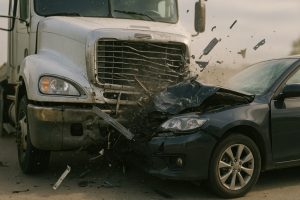 Accidents with commercial vehicles often raise more complicated legal questions than regular car accidents. One of the most critical questions is whether the driver’s employer, in addition to the driver, can be held responsible.
Most times, a business may be at fault for its employees’ bad driving actions if the crash happened while the driver was performing work-related duties. Understanding how to define an employee, what actions are within the scope of employment, and how liability arises and can be shared can make a difference in the outcome of your case. These issues can change how an insurance claim and/or lawsuit is handled, and how compensation is ultimately recovered.
Understanding commercial vehicle liability
Large trucks, delivery vans, and other company-operated vehicles used for business purposes are considered commercial vehicles. Since these vehicles are often used for work-related purposes, the owner and employer are vicariously liable for their drivers negligence. In Florida, the company is also liable as the vehicle’s owner even when the trip is not strictly within the scope of employment. In these cases, figuring out who is responsible for damages or injuries from a collision can be more complex than your average car crash because multiple parties (e.g., employer, insurance companies, and even third-party contractors) can be involved.
When is the employer liable for a commercial vehicle accident?
In most cases, employers are held responsible for accidents caused by their drivers. The doctrine of respondeat superior, which means “let the master answer,” is applied when identifying the responsible party or parties. According to this principle, employers can be at fault for what their employees do while they’re working.
Respondeat superior is based on the premise that businesses benefit from the work of their employees. Therefore, employers should also be responsible when that very work hurts someone.
Scope of employment
For an employer to be held responsible for a commercial vehicle accident, the driver must have been performing work-related duties at the time of the crash, such as:
- Driving a company vehicle during a delivery or service call
- Transporting goods or passengers as part of the job
- Running errands for the employer in a company vehicle
Running a personal errand or operating the vehicle outside of work hours may take the driver outside the scope of employment. However, in Florida the company may still be vicariously liable as the vehicle’s owner under the dangerous-instrumentality doctrine if it gave permission to use the vehicle.
Negligent training or supervision
Employers might also be held liable if they were negligent in training, or supervising the driver. For instance, if a company failed to check a driver’s record and hired the driver with a history of reckless driving or DUIs, the employer may be deemed responsible for any accidents caused by their employee.
Employers have a duty to take reasonable steps to ensure that the drivers they entrust to get behind the wheel of a company vehicle are appropriately vetted, trained and supervised.
Vehicle maintenance and safety
Fault may also extend to the company if they failed to maintain vehicles properly or failed to comply with safety regulations. Consider an employer that didn’t conduct regular upkeep on a delivery truck, and its brakes failed, causing the truck to collide with another vehicle at an intersection. In this situation, the employer or even the cargo loader could be held accountable for the collision.
Not keeping records of inspections, fixing known problems, or complying with regulatory standards can become critical evidence in a claim against a business.
How is liability determined between the driver and the company?
Although both the driver and company may be named as defendants in a lawsuit, liability may not always be shared equally or shared at all. Oftentimes delivery drivers who are working for Amazon, or Door Dash, may somehow be told they are not covered by the company who they are delivering for. The online company may say the driver is a pure independent contractor, and therefore they are not insured by the company with a big insurance policy.
Independent contractors vs. employees
Fault hinges on whether the driver is an employee or an independent contractor and whether the company owns or controls the vehicle. Generally, though, in Florida, the vehicle’s owner can be vicariously liable under the dangerous-instrumentality doctrine even if the driver is an independent contractor.
Several factors go into determining this classification, including, but not limited to:
- The level of control the company has over the driver’s schedule and operations
- Whether the company provides the vehicle
- The terms of any employment or independent contractor agreements between the driver and the company
- Even if the person is driving their own car, they may still be an agent for their company or employer
Misclassification can give rise to a legal issue itself and also impact liability in crashes. It’s not unusual for a company to mislabel employees as independent contractors in an attempt to avoid liability or reduce insurance obligations.
Comparative negligence and shared fault
It’s not uncommon for parties to share or blame fault for an accident. This happens in situations where there are more than one at fault commercial drivers. Here, liability may be apportioned based on each of the corporations degree of fault, too.
What does this mean for commercial vehicle accident victims?
If you were hurt, you have multiple avenues for compensation. You might be able to bring a claim against the following:
- Driver
- Employer
- Vehicle owner
- Truck manufacturer
- Cargo loaders
- Other drivers
- Your own insurance company (e.g., UM/UIM or PIP)
Commercial auto insurance coverage
Companies that operate commercial vehicles typically maintain commercial auto insurance, and certain vehicles are required by federal or state law to carry minimum coverage of $1,000,000. Because of the increased risk and value of business operations, commercial policies often have higher liability limits than many personal auto policies, which can mean there is more insurance available to pay proven injuries and property damage—though your actual compensation still depends on fault, damages, and the specific policy limits.
Gathering evidence
A strong case needs clear, comprehensive, and consistent evidence like police reports, witness statements, vehicle maintenance records, driver logs, employment records, and insurance information. Collecting relevant evidence helps establish liability and damages.
Safety rules for commercial drivers
Most of the time, commercial vehicle liability cases require lengthy, detailed investigations and knowledge of specific laws and regulations. For example, the Federal Motor Carrier Safety Administration sets safety rules that commercial drivers must follow, which might impact a case.
Contact MattLaw to discuss your case
When a commercial vehicle accident happens, liability may extend beyond the employee to their employer or the independent contractor to the company they work for. Knowing how liability is assigned and what factors establish responsibility can guide you in pursuing compensation for your injuries and losses.
If you’ve been hurt by a commercial vehicle driver, contact us to discuss your case and walk you through your legal options. MattLaw Car Accident & Personal Injury Lawyers is committed to thoroughly reviewing the facts of your case, evaluating all responsible parties (including the employer or company), and helping you pursue the compensation you deserve.
About Author

Matt Powell is a Board Certified Civil Trial Lawyer by the Florida Bar who represents injured victims and their families. He is an experienced personal injury trial attorney who has been practicing since 1989 in Tampa, Florida. Simply call our offices or fill out our contact form to schedule a free consultation today.